Long and short positions
Understand how the position directes the result.
Long and short
position Open participation in the price of the tool. Long, or a long position, wins from the price rise and loses from the fall. For simple purchase result to costs:
(The price of the entrance is the price of the entry)
ShortFor example, for a short sale of loans stock first sell shares and then buy them to return. In contracts mechanics different. Press “Sell” your own asset – usually means reducing or closing long, rather than automatically opening short.
For a simple linear short-position, the result to the cost: (Input price - Exit price) × NumberIn this short course we study as a concept; the educational calculations will be further performed on long without a shoulder.
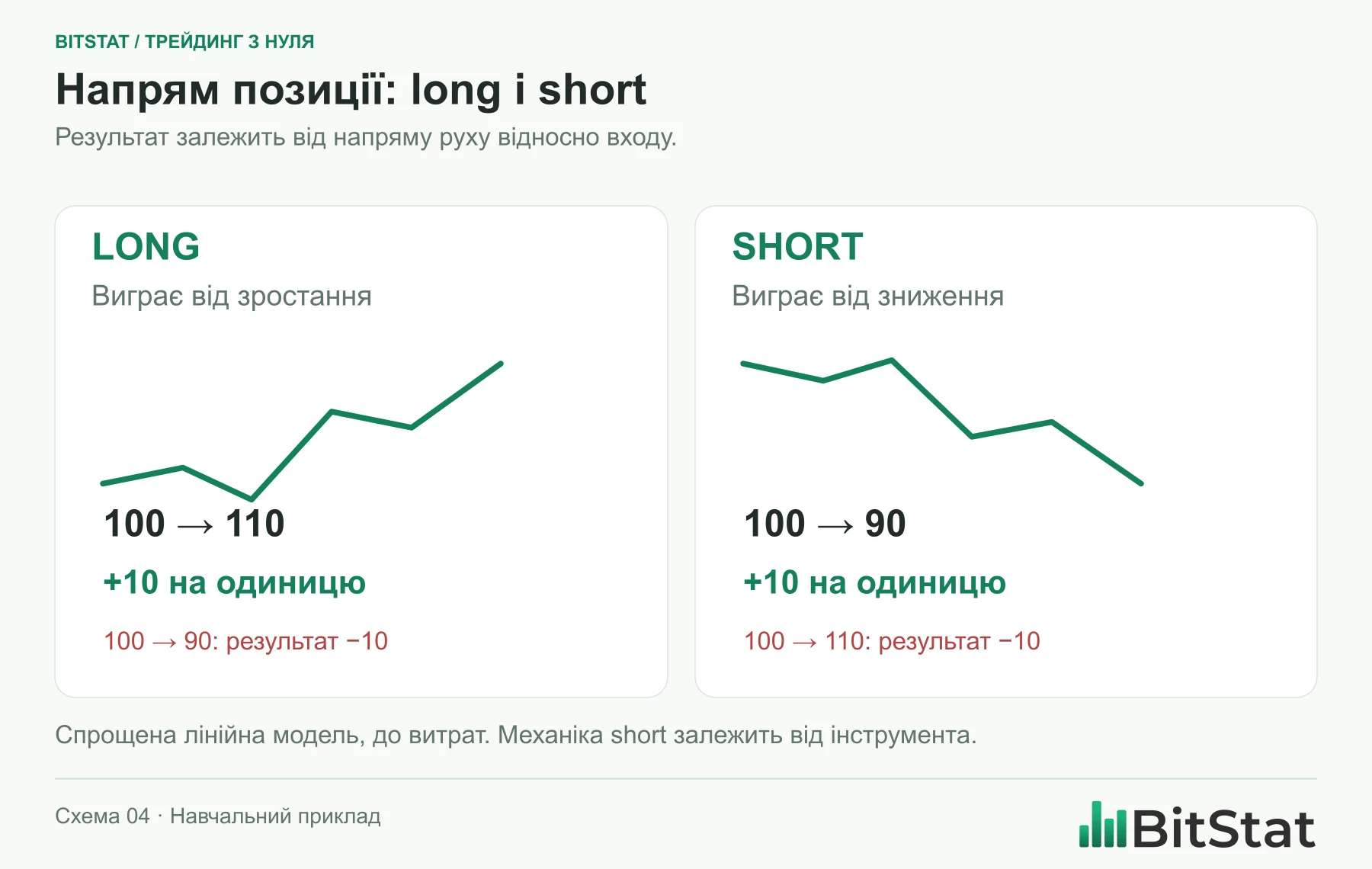
The position is not equal to the duration.
The words “long” and “short” here do not mean how long you will hold a position. Long can take a few minutes, and short – much longer. They describe the result’s dependence on the direct price.
Comparing two conditional linear positions with the input of 100 and a number 3. If the output is 104, long will give +12 to costs, and short -12. If the outcome is 96, the signs are changed: long -12, short +12. This is an arithmetic symmetry rather than proof of the same rules or risks of products.
Sales can perform different actions.
Let’s say you already have 5 units of asset. Selling 2 will reduce the remains to 3, and selling all 5 will close possession. This is not creating a huge amount. To open short, separate options and conditions of the tool are required.
In short sale of borrowed shares, important rules for the loan and return. The price of the stock can rise without a pre-established upper limit, so the potential loss of such short is not limited to the initial price of sale. Source: SEC on short salesFor different contracts, mechanics and requirements are different: the formula of a simple example cannot be transferred to any product without checking.
Minipractic
You bought 4 units for 25 and sold only 1 for 27. What amount remains and what result from the selling part to expenses?
Check the answer
left 3 Units long. by sold unit result (27 - 25) × 1 = +2The result of the remaining position is still changing with the price. Short in this example does not appear.