Highs and lows
Learn to find local extremes on the graph.
From the locals to the top
Every candle has high and low. But not every high is a noticeable top of movement. Local maximum the top of neighboring values, Local minimum The word “local” means that we compare a limited section of the graph.
For this exercise we agree on a simple rule: the maximum of a central candle must be strictly higher than the maximum of one candle to the left and one right. To minimize its Low must be striktly lower than both neighboring Low. This is a learning rule, not the only possible definition.
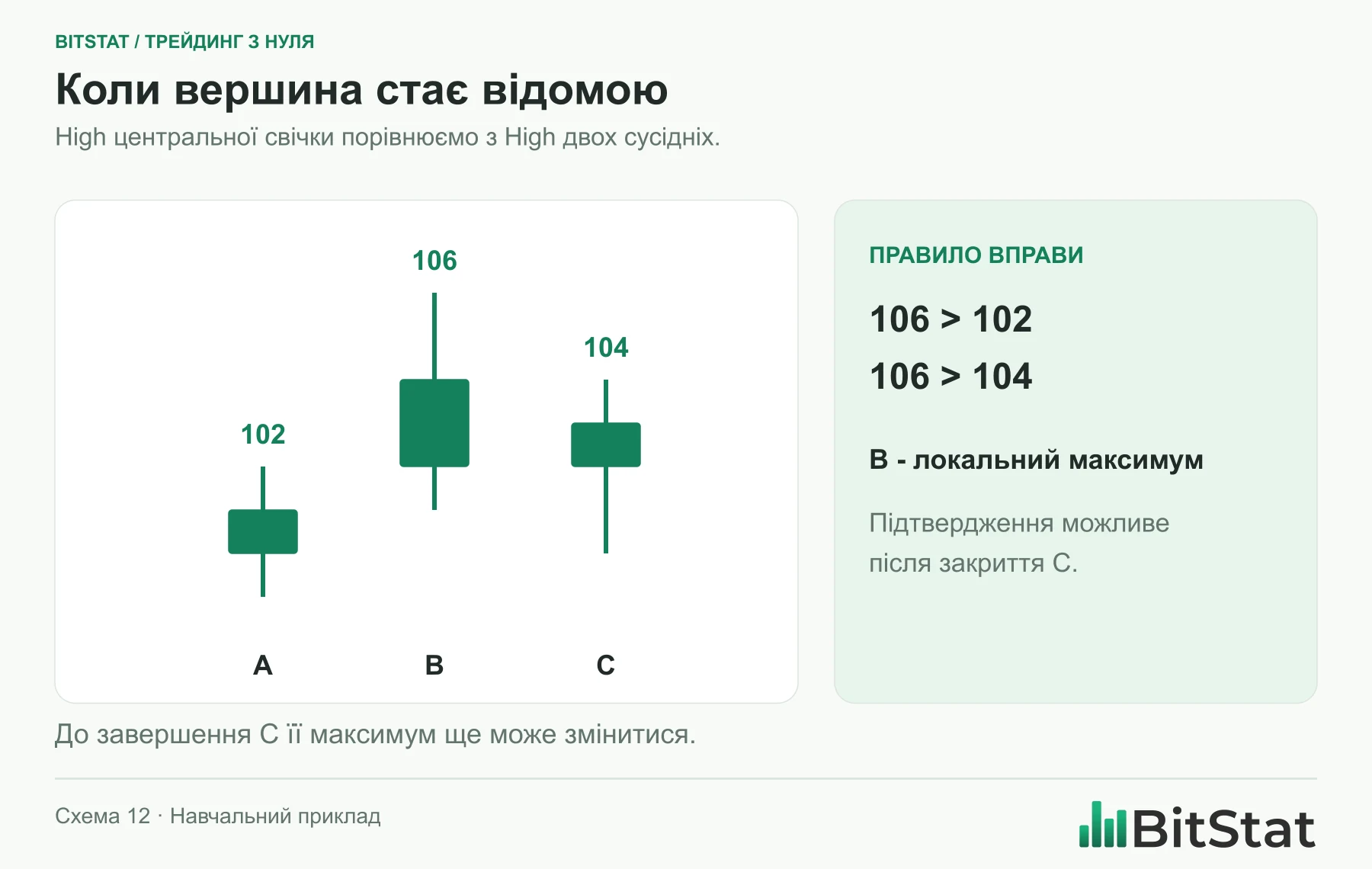
Examples of check
| Candle | High | Low |
|---|---|---|
| A | 102 | 99 |
| B | 106 | 101 |
| C | 104 | 100 |
High candles B equal to 106 and higher than 102 and 104. According to our rule, B is the local maximum. Its Low 101 is not lower than both neighboring minimis, so it is not the local minimum.
If two neighboring maximum equal, the condition of "strictly higher" is not fulfilled. Do not change the rule by the back number to get the desired point. In other methods the level top can be processed differently - it must be determined to the volume.
Why confirmation is delayed
Until the candle C has closed, its High can rise above 106. So at the time of closing B we don't know if it will become a confirmed top. On the finished chart it is easy to forget and use information that was not there then.
In the history check, open on one of the next candles. Mark a point only when all the necessary data are already available. This helps to avoid future views.
Minipractic
High five closed candles: 100, 103, 101, 105, 102. According to the rule of one neighbor on each side, the maximum is the second and fourth candles. The first and last are not assessed: in the aforementioned fragment they lack a neighbor. Repeat the correct for Low: 97, 99, 96, 100, 98. Local minimum is the third candle.
The summary: The mixture requires a clear rule and the moment when the point really became known.